
AWARDS FINALIST: Transpower and Engineering NZ – Wonder project: Power challenge – Powering up our future workforce
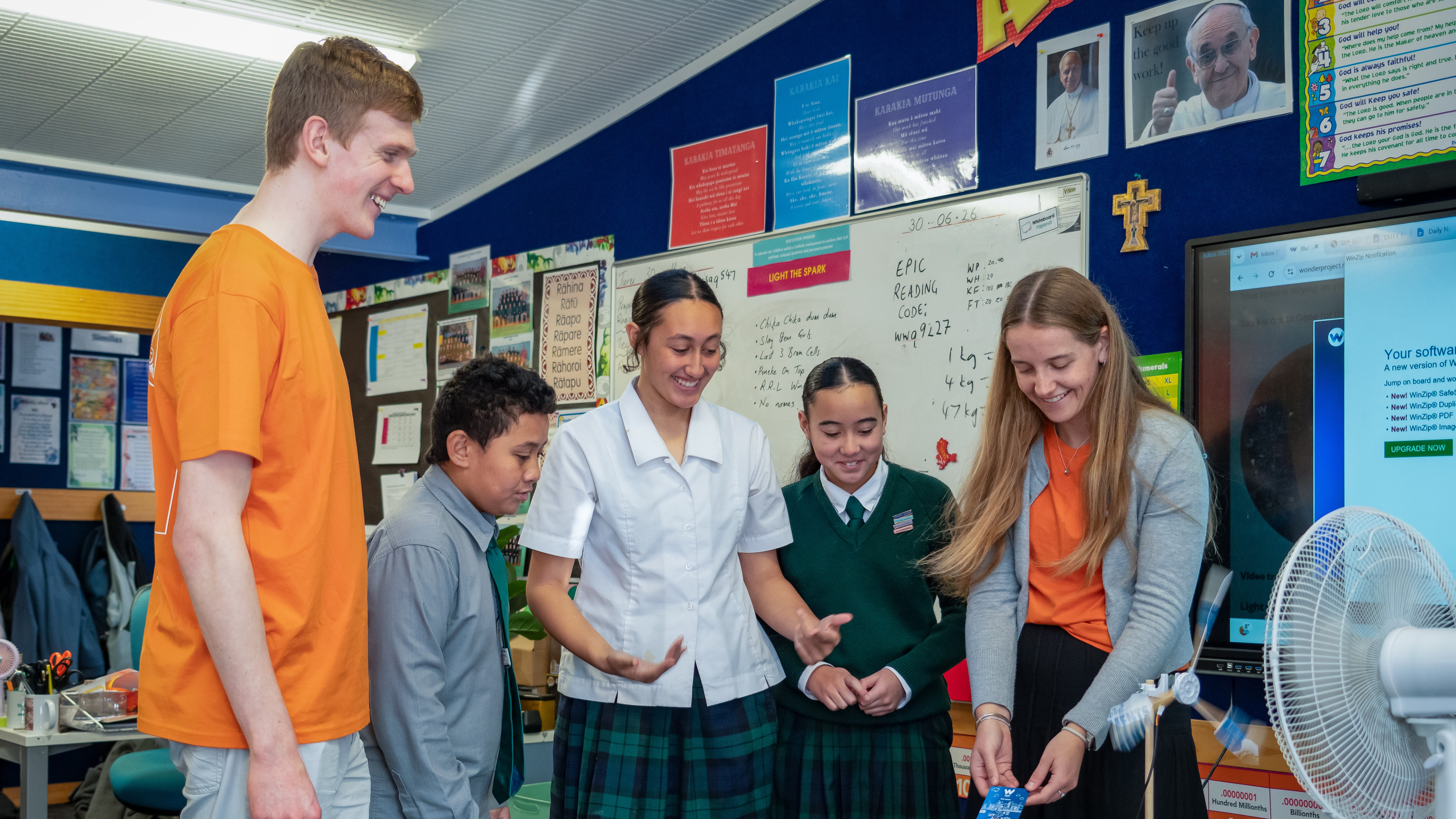
Transpower and Engineering New Zealand's Wonder Project: Power Challenge reached more than 11,000 students this year - double the number last year - as part of their push to ensure the workforce needed to build, maintain and operate the "grid of the future".
The free hands-on classroom programme introduces Year 7 and 8 students to electricity generation, transmission and renewable energy concepts.
Developed in 2021, the science, technology, engineering and maths initiative was in response to concerns about New Zealand's engineering workforce pipeline as electrification drives up demand for skilled workers.
Engineering New Zealand reports a shortfall of about 2300 new engineers each year, and only 9 per cent of New Zealand tertiary graduates studying engineering.
As far back as 2018, Transpower's modelling predicted a workforce shortfall risk and predicted that meeting the expertise required would not be achieved by short-term hiring increases.
Transpower says that showed longer-term investment was needed in STEM engagement for school-age students in addition to existing workforce development initiatives.
"The sector needs to build and support a sustained pipeline of talent over decades," it says.
Collaborative design
Transpower and Engineering New Zealand are finalists in this year's Energy Excellence Awards for the Wonder Project: Power Challenge they developed to spark interest in engineering and electricity careers.
"Targeting tamariki at an age when their future career prospects have not yet consolidated, the Power Challenge builds on the Wonder Project's existing success in shifting both teachers' and students' knowledge and confidence in engaging with STEM and the careers it can offer," says Transpower's Brighid Kelly.
Teams from the organisations designed a challenge kit for students to build a model town connected to transmission infrastructure, while exploring electricity generation from wind, solar and other renewable sources.
The initiative was piloted in 30 classrooms in 2021, before expanding through a second-phase pilot involving 236 schools in 2022 and a nationwide rollout later that year.
Following feedback that the kit and concepts were "overly complex", the organisations made further changes to simplify the materials.
They also increased student engagement through competitive design and testing activities.
Ambassadors, outcomes
Transpower also supplies a steady pipeline of staff "ambassadors" - STEM professionals who volunteer to support teachers and students in delivering the challenge.
It considered several options to "win the hearts and minds of young would-be engineers" as well as build stronger community relationships.
It decided a successful programme would allow Transpower's engineers and other STEM-qualified staff to "speak directly to tamariki, making these often 'invisible' professions tangible and real, and to model by example what a career in the sector looked like".
The partnership has also drawn on Transpower's industry connections to build support for the programme across the sector, with the Energy Efficiency and Conservation Authority and Omexom now among the sponsors.
The programme's scale has increased significantly since it was launched. Transpower and Engineering New Zealand say the challenge reached 26,767 students during its first five years.
With 410 classes enrolled in 2026, that number is expected to rise to 37,767.
Annual impact reporting indicates changes in student and teacher perceptions of STEM.
In 2025, 87 per cent of teachers reported a positive shift in how students viewed STEM subjects, while 67 per cent of participating students said the programme improved their confidence in STEM.
Forty-one per cent reported greater interest in STEM careers after completing the challenge.
The programme also reported gains in electricity-related knowledge. According to the 2025 impact report, there was a 38 per cent increase in students who said they knew "quite a bit" about electricity, while 18 per cent more students could correctly identify renewable energy concepts and 52 per cent more could explain how to improve wind turbine performance.
Inclusion
Participation has also increased among schools facing higher barriers to inclusion.
Last year, 44 per cent of participating schools were classified as having high barriers to inclusion, while 25 per cent of participating students identified as Māori and 15 per cent as Pacific Peoples.
A further milestone was achieved last year when the programme was translated into te reo Māori to support delivery in kura kaupapa and Māori immersion classes.
Participating students from these schools reported changes in attitudes towards STEM.
The organisations say anecdotal responses are particularly vivid in capturing the "magical 'lightbulb' moment of conceptual understanding", and the power of students learning they can apply this to the world around them.
One participant, from Poukawa School in Hawke's Bay, said: "It has changed my thoughts about STEM and now when I see things, I wonder what went into making it."
The annual Energy Excellence Awards will be held in Wellington on 19 August. The FutureForce Award is sponsored by Ngākau Hihiko.