
AWARDS FINALIST: BraveTrace – NZES: Proof that powers decarbonisation
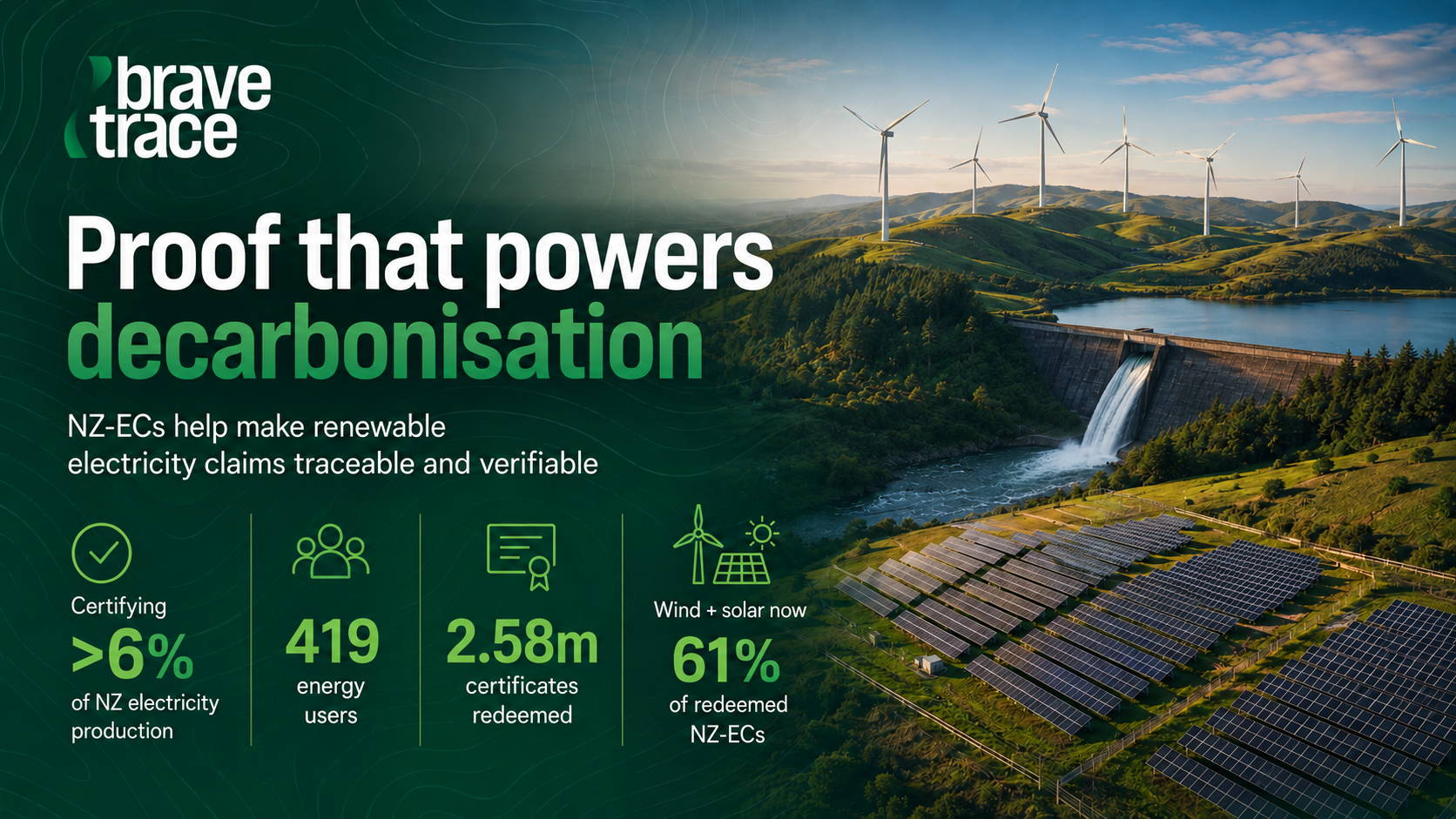
BraveTrace is turning renewable energy claims into proven climate action, with its renewable energy certification system supporting new renewable generation investment and underpinning verifiable emissions reporting.
The New Zealand Energy Certificate System supports renewable generation, returning additional proceeds to renewable asset operators and developers to support investment signals for new renewable build and repowering.
BraveTrace says the certification improves the "value capture" of renewable attributes, provides clearer signals about what the market wants and provides an additional revenue stream for renewable energy generators alongside electricity sales.
Each year, NZ-ECs generate approximately $15 million to $20 million in additional revenue to fund renewable energy projects across Aotearoa.
The NZ-EC model also extends beyond electricity, with the same platform also able to serve adjacent markets, including the renewable biomethane certification it already offers and other pathways currently in development.
Other stakeholders also benefit.
By reducing the "double-counting" of positive generation use, customers gain a clearer understanding of what "credible renewable" means, as well as stronger audit readiness, a reduced assurance burden and improved tender and supply-chain compliance.
BraveTrace says the wider market also gains higher trust in renewable claims, better transparency, and a practical mechanism that supports New Zealand's net-zero transition as electricity demand rises.
The company has established partnerships with energy retailers and generators including Meridian Energy, Mercury, Genesis Energy and Lodestone.
Market-based system
BraveTrace, a finalist in this year's Energy Excellence Awards, says the NZECS is a market-based system funded through certificate transaction fees across registered participants and users.
Prior to NZECS, there was no New Zealand-specific system designed to substantiate renewable electricity claims.
BraveTrace developed the certification system to address growing demand for credible renewable energy claims as electrification increases electricity demand and businesses face greater scrutiny around emissions reporting.
Each certificate represents 1 megawatt-hour of verified renewable energy generation and is redeemed when used.
BraveTrace reports it is continuing to see growth in its renewable energy certification programme, passing 400 energy users in the past year.
In the 2024/2025 year, 2.16 million certificates were redeemed, covering 2.16 terawatt-hours of electricity consumption - 5.2 per cent of New Zealand's total electricity generation.
In its recent annual production year report for the 12 months to 31 March, that had risen to 2.6 million certificates, representing about 6 per cent of the country's total electricity production.
BraveTrace says uptake of its programme has occurred "without government mandates, grants or subsidies", and is scaling alongside the market, as more firms opt to verify renewable energy consumption and support market-based Scope 2 emissions reporting.
Its channel distribution model uses retailers, brokers and advisers to embed NZ-EC procurement into contracts and reporting workflows, which reduces customer acquisition cost, increases renewals and makes adoption practical in day-to-day procurement.
Registry upgrade
BraveTrace has launched several new platform features and communication tools in the past year, including its customer-facing "BraveTrace Stamp" that identifies organisations using NZ-ECs.
It has also launched its production devices database of registered renewable generation assets.
A major project was its "Registry v2" - an upgrade to its registry platform which has improved system performance, reliability and scalability.
Further modifications have supported its move to more flexible quarterly transaction periods while maintaining annual reporting requirements and reflect the changing needs of the market as it evolves.
A key feature of the registry is its residual supply mix accounting system.
BraveTrace publishes residual supply factors and removes renewable attributes from the residual mix once certificates have been claimed and redeemed.
That helps maintain transparency and prevents multiple parties claiming the same renewable electricity attributes.
The annual Energy Excellence Awards will be held in Wellington on 19 August. The Low Carbon Future Award is sponsored by TechnologyOne.